
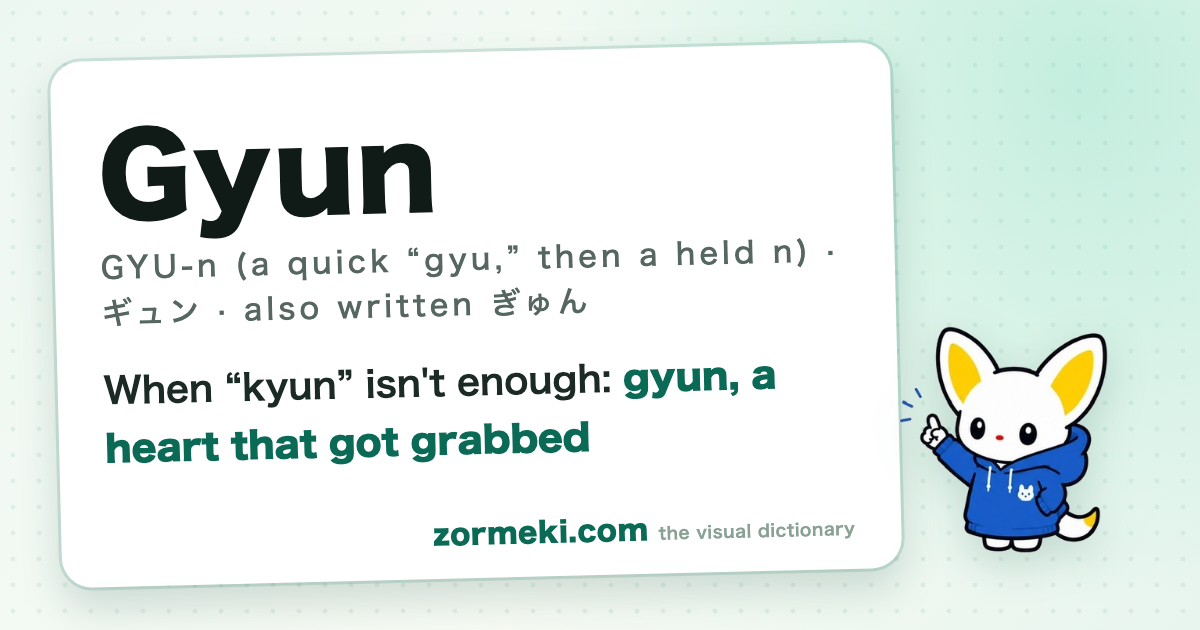
GyunGYU-n (a quick “gyu,” then a held n) · ギュン · also written ぎゅん
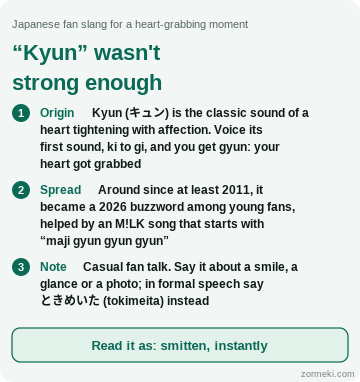
Gyun (ギュン) is Japanese slang for a heart-squeeze stronger than kyun (キュン): the jolt you feel when someone's look, words or gesture grabs your heart.
Last updated 2026-11-23
Use this diagram in videos & articles (free)
Free to use in videos, articles and streams. Use in ads or products requires a paid license (contact form at the bottom of the page).
Embed code (copy and paste as is):
Save the image file (SVG) — When you use it, please add a link to this page

Quick facts
| Reading | gyun (ギュン): two beats, “gyu” plus a held “n,” rhyming with kyun. Usually written in katakana; the hiragana ぎゅん also appears |
|---|---|
| Meaning | A sudden, strong squeeze of the heart from attraction or affection: “smitten,” “that got me” |
| Built from | kyun (キュン), the classic Japanese sound of a heart tightening with affection, with its first sound voiced: kyu becomes gyu |
| Who says it | Fans talking about idols and their favorites (oshi), and anyone talking about a crush, mostly on social media |
| Common forms | ギュン (gyun), ギュンです (gyun desu), ギュンきた (gyun kita, “it got me”), ギュンした (gyun shita), ギュンすぎる (gyun sugiru, “way too gyun”) |
| Register | Casual and playful. In formal speech, say ときめいた (tokimeita, “my heart fluttered”) instead |
What it means
Japanese has a ready-made sound for the moment your heart tightens with affection: kyun (キュン). See your favorite idol catch another member in a hug, and your heart goes kyun. Gyun is that same sound with a heavier first consonant, and it changes the message from “aww, my heart fluttered” to “that grabbed my heart.” Hiragana Times glosses it simply as “smitten” and says it is used when one's heart is strongly grabbed, in romance or by the words and actions of one's oshi.
It names your reaction in the moment, not the person who caused it. You say a smile was gyun, or that a glance made you gyun; you do not call someone “a gyun.” It also works as a verb: if your heart did it, you gyun shita (ギュンした).
Part of the word's 2026 visibility comes from music. The music video for the idol group M!LK's song 「好きすぎて滅!」 (Suki Sugite Metsu!, roughly “I like you so much I'm done for”) begins with maji gyun gyun gyun rather than maji kyun kyun kyun, and Japanese youth-slang articles link that song to the word's rise among young fans.
How the word is built
Use this diagram in videos & articles (free)
Free to use in videos, articles and streams. Use in ads or products requires a paid license (contact form at the bottom of the page).
Embed code (copy and paste as is):
Save the image file (SVG) — When you use it, please add a link to this page
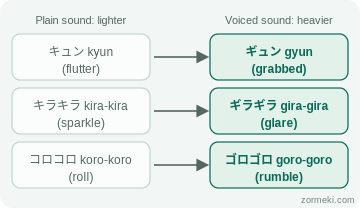
The change is one small mark. Japanese writes a voiced consonant by adding two short strokes, called dakuten (゛), to a kana: キ (ki) becomes ギ (gi). Hiragana Times puts the effect plainly: adding the dakuten increases the force and impact.
That is not a one-off trick. Japanese sound words (onomatopoeia and mimetic words) regularly come in pairs, a light, clean form and a voiced, heavier one, and native speakers read the voiced side as bigger, rougher or stronger without being told. Gyun slots into that pattern, which is why Japanese speakers understand it on first sight.
Kyun vs. gyun
Think of the two as the same feeling at two volumes. Kyun is the everyday word: sweet, light, and still very much alive in 2026, when it even got a new catchphrase, 最初はキュン (saisho wa kyun), from singer Kento Nakajima's April 2026 song that turns the rock-paper-scissors chant into a love chant. Gyun is for when “kyun” undersells it: the moment hit harder or more suddenly than a flutter. The two sit side by side, and choosing one over the other tells your friends how hard the moment hit.
The nearest English is “smitten,” “that got me,” or “my heart just jumped.” None of them carries the sound joke, which is the point of the word: the extra weight is in the consonant.
Timeline
Use this diagram in videos & articles (free)
Free to use in videos, articles and streams. Use in ads or products requires a paid license (contact form at the bottom of the page).
Embed code (copy and paste as is):
Save the image file (SVG) — When you use it, please add a link to this page
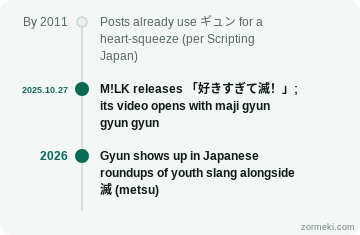
The learner's dictionary Nihoner lists ぎゅん as another form of きゅん, glossed as a momentary tightening of the chest caused by powerful feelings, so the sound itself was on record before it became a buzzword.
How it's used
The examples below were written by our editors to show usage. They are not quotations of real posts.
Keep it for friends and fan talk. It sounds playful and high-energy, not like a neutral word for liking someone.
Common misunderstandings
Use this diagram in videos & articles (free)
Free to use in videos, articles and streams. Use in ads or products requires a paid license (contact form at the bottom of the page).
Embed code (copy and paste as is):
Save the image file (SVG) — When you use it, please add a link to this page
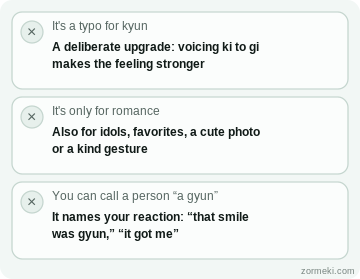
Outside fan talk, ぎゅん is also an ordinary sound effect for something moving fast, so context tells you which one you are reading.
Where this is heading
This section is our editorial analysis. Sourced facts are kept in the sections above.
The phenomenon behind gyun is intensifier inflation in fan vocabulary. A word for strong feeling gets used so often that it starts to sound ordinary, and fans reach for a heavier version. The same thing happened to meroi (メロい, “heart-melting”), a 2024 new word that by 2026 had picked up the boosted form dokamero. Kyun to gyun is the same move made with a single consonant.
What makes this case interesting is that the old word did not disappear. Kyun picked up a fresh catchphrase in 2026 at the same time gyun was rising, so Japanese now has both volumes in active use. For learners, the practical takeaway is the pattern rather than the single word: when a familiar Japanese sound word suddenly appears with dakuten, read it as the same feeling turned up.
Related terms
Featuring this word in a video or article?
The diagrams on this page are free to use in videos, articles and streams.
“Gyun” meaning, explained with diagrams https://zormeki.com/en/words/gyun/
Save or embed a diagram (tap one for options):
Sources
- Hiragana Times, “Gyun (Smitten) ギュン” (Nov 20, 2026; December 2026 issue) — the gloss “smitten,” use in romance and for one's oshi, and the dakuten adding force and impact
- Nihongo Slang, “ギュン (gyun) meaning, usage & examples” — the common forms, the reaction-not-person point, the casual register and the formal alternative ときめいた, and 2026 Japanese youth-slang coverage linking it to M!LK's song
- Scripting Japan, “Japanese Slang Review – October 2026” (Wesley C. Robertson, Oct 31, 2026) — the kyun example, the verb form ギュンした, use in this sense by 2011 at the latest, its use as a general sound effect, its listing among popular 2026 words, the M!LK music video, and 最初はキュン from Kento Nakajima's April 2026 song
- Nihoner, “ぎゅん” (Aug 13, 2026) — the dictionary listing of ぎゅん as a form of きゅん
- M!LK official site (Oct 20, 2025, Japanese) — the digital release of 「好きすぎて滅!」 on October 27, 2025
- Hiragana Times: Gyun (Smitten) ギュン (Nov 20, 2026)
- Nihongo Slang: ギュン (gyun) meaning, usage & examples
- Scripting Japan: Japanese Slang Review – October 2026 (Oct 31, 2026)
- Nihoner: ぎゅん (Aug 13, 2026)
- M!LK official: 「好きすぎて滅!」 release announcement (Oct 20, 2025, Japanese)
Last verified: 2026-11-23