
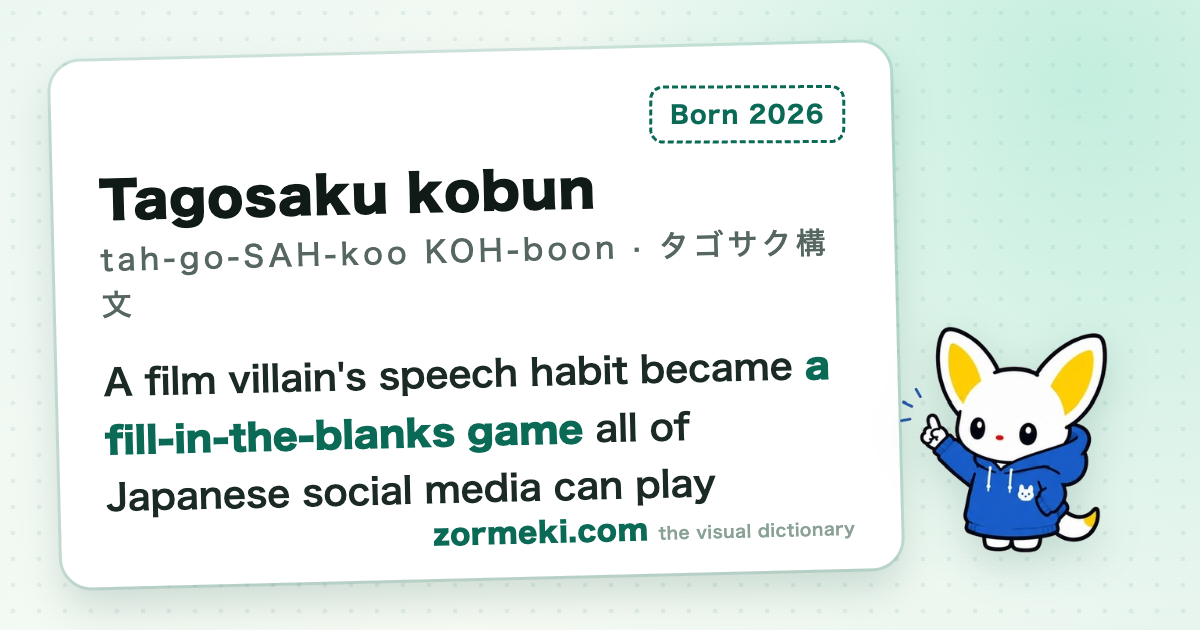
Tagosaku kobuntah-go-SAH-koo KOH-boon · タゴサク構文
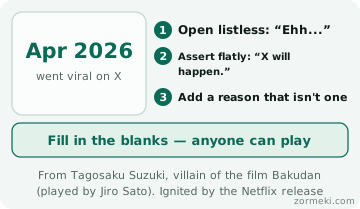
Tagosaku kobun (タゴサク構文, “the Tagosaku template”) is a Japanese internet meme that imitates the speech style of Tagosaku Suzuki, the unsettling villain of the film Bakudan (“Bomb,” 2025), played by Jiro Sato. The template — a listless “Ehh...,” a flat assertion, then a reason that isn't really a reason — exploded across X (Twitter) in April 2026 after the film hit Netflix, because anyone can fill in the blanks and join the joke.
Last updated 2026-08-14
Use this diagram in videos & articles (free)
Free to use in videos, articles and streams. Use in ads or products requires a paid license (contact form at the bottom of the page).
Embed code (copy and paste as is):
Save the image file (SVG) — When you use it, please add a link to this page

Quick facts
| Source | The speech style of Tagosaku Suzuki, the villain of the Japanese film Bakudan (“Bomb,” released Oct 2025; based on the 2022 novel by Katsuhiro Go), played by actor Jiro Sato |
|---|---|
| The template | “Ehh... [X] will [happen]. Because [Y].” — where Y sounds like a reason but isn't one |
| When it went viral | April 2026, right after the film's Netflix release on March 31, 2026 |
| Family | The latest in Japan's “kobun (構文) meme” lineage — named speech templates such as the Shinjiro kobun (a politician's circular speech style) |
| Reach | Joke posts on X, regional in-jokes, comedians' and VTubers' video formats. Jiro Sato himself thanked fans for the trend (May 2026) |
What it means

Tagosaku kobun is a game of imitating how Tagosaku Suzuki talks in the film's interrogation-room scenes. The pattern: open with a listless “Ehh...” (えー), state something flatly as fact, then attach a justification that sounds reasonable but never actually connects. In the film that mismatch reads as menace; in the meme it reads as comedy.
The timing is the interesting part. The film opened in Japanese theaters in October 2025, but the meme only ignited after the Netflix release on March 31, 2026, when the film topped the weekly streaming chart for weeks and everyone could finally watch it. Because the template is fixed, you don't need to have seen the film to play — people plugged in local-pride jokes (“Ehh... [X] is Kagoshima. Because it is Kagoshima.”), comedians built sketches on it, and VTubers turned it into a video format.
This site is not affiliated with the film or its makers.
How the word is built
Use this diagram in videos & articles (free)
Free to use in videos, articles and streams. Use in ads or products requires a paid license (contact form at the bottom of the page).
Embed code (copy and paste as is):
Save the image file (SVG) — When you use it, please add a link to this page
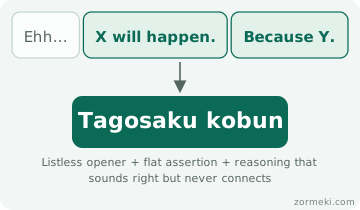
“Tagosaku” is the character's given name; kobun (構文) means “syntax” or “sentence template.” Japanese internet culture has a running tradition of naming a distinctive way of talking “◯◯ kobun” and reusing it as a template — closer to a copypasta format than to an image meme, and a genre that has developed much further in Japanese than in English.
The template has three parts:
- 1. “Ehh...” (えー、)a listless, unmotivated opener
- 2. “[X] will [happen].”an alarming statement delivered like a routine office memo
- 3. “Because [Y].”shaped like a reason, but on inspection it explains nothing
The gap between parts 2 and 3 — logic that sounds connected but isn't — is the whole point.
Is there an English equivalent?
There is no established translation. The closest English concepts are the copypasta (a reusable text format) and the snowclone (“X is the new Y”), but Japan's kobun culture — naming a real speech style after a person or character and mass-producing fill-in-the-blank variations — has no direct counterpart. If you need a one-line gloss: a copypasta-style speech template from the film Bakudan.
Timeline
Use this diagram in videos & articles (free)
Free to use in videos, articles and streams. Use in ads or products requires a paid license (contact form at the bottom of the page).
Embed code (copy and paste as is):
Save the image file (SVG) — When you use it, please add a link to this page
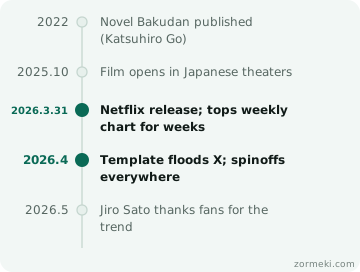
| 2022 | The novel Bakudan by Katsuhiro Go is published |
|---|---|
| Oct 2025 | The film adaptation opens in Japanese theaters; Jiro Sato's performance becomes a talking point |
| Mar 31, 2026 | Netflix release; the film tops the weekly streaming chart for consecutive weeks |
| Apr 2026 | Template posts flood X; regional jokes and video formats follow |
| May 2026 | Jiro Sato publicly thanks fans for the trend; national press covers the phenomenon |
How it's used
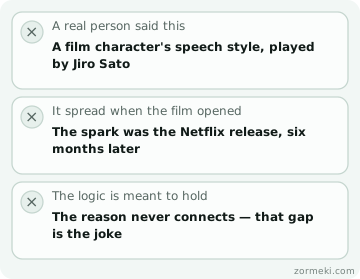
Common misunderstandings
Use this diagram in videos & articles (free)
Free to use in videos, articles and streams. Use in ads or products requires a paid license (contact form at the bottom of the page).
Embed code (copy and paste as is):
Save the image file (SVG) — When you use it, please add a link to this page
Where this is heading
This section is our editorial analysis. Sourced facts are kept in the sections above.
The clearest lesson of this meme is that the center of gravity of film buzz in Japan has moved from theatrical release to streaming release: the template sat dormant for six months and exploded the moment everyone could watch the film at home. And with the actor himself publicly welcoming the trend, studios can now treat memes as free marketing — expect future Japanese films and dramas to be promoted with an eye on “does this give viewers an easy template to imitate at streaming launch?”
The other takeaway is the durability of kobun culture itself. Every few years a new named template appears, and each time the same fill-in-the-blank game repeats — the kobun works as the smallest unit of fan creation that anyone can join. When the next distinctive way of talking appears in Japanese media, it will almost certainly be consumed the same way.
Featuring this word in a video or article?
The diagrams on this page are free to use in videos, articles and streams.
“Tagosaku kobun” meaning, explained with diagrams https://zormeki.com/en/words/tagosaku-kobun/
Save or embed a diagram (tap one for options):
Sources
- Real Sound Movie (June 2026) — “What is the Tagosaku kobun trending on social media?” — source for how the trend spread
- Modelpress (May 2026) — Jiro Sato thanks fans for the Tagosaku kobun trend
- KAI-YOU — regional VTubers adopting the Suzuki Tagosaku kobun
- Real Sound Movie: What is the “Tagosaku kobun” trending on social media? (Japanese)
- Modelpress: Jiro Sato thanks fans for the trend (Japanese)
- KAI-YOU: Regional VTubers and the Suzuki Tagosaku kobun (Japanese)
Last verified: 2026-08-14