
Dolce NonnaDOL-cheh NON-nah
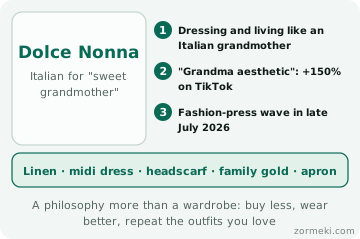
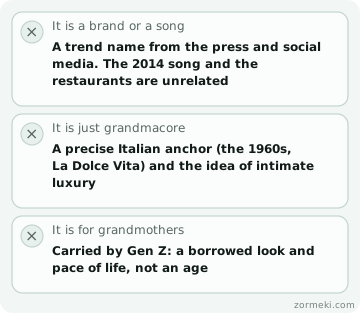
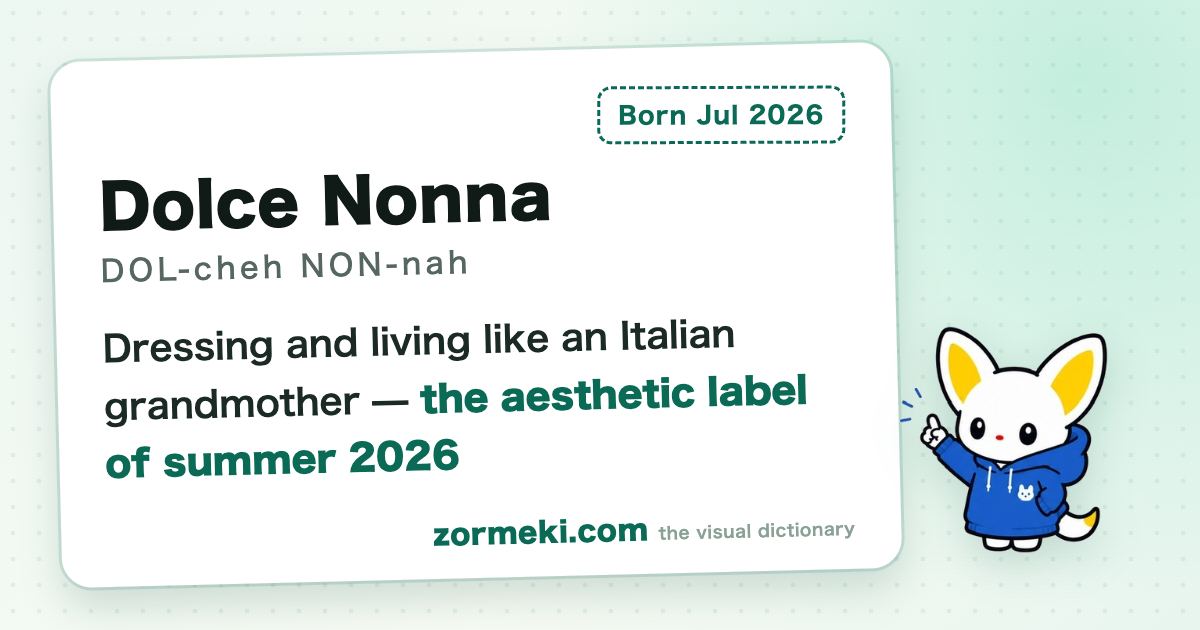
Dolce Nonna (Italian for "sweet grandmother") is the name of an aesthetic that went viral in summer 2026: dressing and living like an Italian grandmother. Crinkled linen shirts, floral midi dresses, a scarf knotted in the hair, heirloom-style gold jewellery, comfortable sandals — and a philosophy: buy less, wear better, repeat the outfits you love. The label took hold in the fashion press at the end of July 2026, riding a surge of "grandma aesthetic" searches on TikTok. It is unrelated to the 2014 easy-listening song of the same name.
Last updated 2026-08-08
Use this diagram in videos & articles (free)
Free to use in videos, articles and streams. Use in ads or products requires a paid license (contact form at the bottom of the page).
Embed code (copy and paste as is):
Save the image file (SVG) — When you use it, please add a link to this page
The essentials
| Term | Dolce Nonna (Italian: "sweet grandmother") |
|---|---|
| Meaning | An aesthetic of dressing and living like an Italian grandmother: linen, midi dresses, headscarf, gold heirlooms, a slow pace of life |
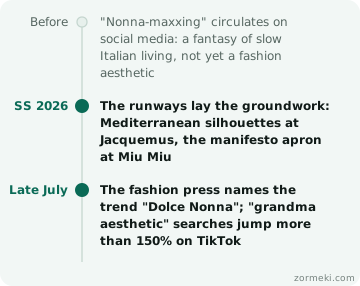
| When | Fashion-press wave from July 30 to August 3, 2026; "grandma aesthetic" searches up more than 150% on TikTok |
| Where it came from | An evolution of "nonna-maxxing", the slow-life fantasy that circulated on social media before becoming a fashion label |
| Spirit | Buy less, wear better, repeat your favourite outfits — an intimate kind of luxury rather than a quiet one |
Overview
Use this diagram in videos & articles (free)
Free to use in videos, articles and streams. Use in ads or products requires a paid license (contact form at the bottom of the page).
Embed code (copy and paste as is):
Save the image file (SVG) — When you use it, please add a link to this page
Dolce Nonna is the summer-2026 edition of an exercise fashion repeats every season: giving a way of dressing a name so it can become a trend. This time the model is not a celebrity but a familiar figure: the Italian grandmother from 1960s family photographs, the woman who dresses "to live, not to be photographed".
In practice the aesthetic assembles simple, durable pieces: a slightly crinkled linen shirt, a printed midi dress, a scarf knotted in the hair, tinted glasses, comfortable sandals, gold jewellery that looks inherited, an apron, a cardigan worn for decades. The fashion press adds a way of life: homemade pasta, long walks, meals that stretch on.
The phenomenon reaches beyond social media: the spring–summer 2026 runways had already laid the groundwork — Mediterranean silhouettes at Jacquemus, and above all the apron sent down the Miu Miu runway, worn by the actress Sandra Hüller and read as a fashion manifesto.
Where the term comes from
Use this diagram in videos & articles (free)
Free to use in videos, articles and streams. Use in ads or products requires a paid license (contact form at the bottom of the page).
Embed code (copy and paste as is):
Save the image file (SVG) — When you use it, please add a link to this page
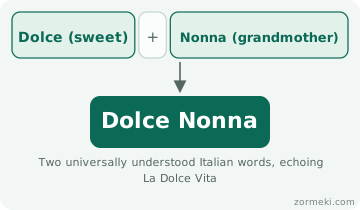
Dolce ("sweet") + nonna ("grandmother"): two Italian words everyone understands, put together on the model of La Dolce Vita — the film that provides the trend's visual reference, with 1960s Italy as the backdrop.
Before it became a trend name, the idea circulated as "nonna-maxxing": a fantasy of slow Italian living shared on social media. In summer 2026 the fashion press reworked that fantasy into a ready-made aesthetic label, in the lineage of earlier ones — quiet luxury, coastal grandmother, mob wife — but with a different angle: the domestic and the intimate rather than display.
How it is used
Common misconceptions
Use this diagram in videos & articles (free)
Free to use in videos, articles and streams. Use in ads or products requires a paid license (contact form at the bottom of the page).
Embed code (copy and paste as is):
Save the image file (SVG) — When you use it, please add a link to this page
Where this is heading
This section is editorial analysis. Sourced facts are in the sections above.
Dolce Nonna belongs to a broader movement: fatigue with disposable wardrobes and algorithm-dictated trends. Earlier labels already signalled it — quiet luxury praised discretion, coastal grandmother praised comfort. This one goes a step further by holding up as a model a figure who, precisely, ignored trends: nobody imagines a nonna changing style every season.
The commercial recapture has begun: the spring–summer 2026 runways (the Miu Miu apron, Jacquemus's Mediterranean silhouettes) show the houses have smelled the opportunity; if "Italian-style" capsule collections multiply, the anti-consumption label will paradoxically become a sales pitch.
Featuring this word in a video or article?
The diagrams on this page are free to use in videos, articles and streams.
“Dolce Nonna” meaning, explained with diagrams https://zormeki.com/en/words/dolce-nonna/
Save or embed a diagram (tap one for options):
Sources
- Vogue France, "'Dolce Nonna': pourquoi la Gen Z veut désormais s'habiller comme une grand-mère italienne" (July 30, 2026) — definition, codes, TikTok statistic, runway references
- iO Donna, "Dolce Nonna, la tendenza TikTok dell'estate 2026" (August 3, 2026) — nonna-maxxing origin, style elements, designer contributions
- Newsweek, "What is 'nonna maxxing'? Meet Gen Z's guilt-free answer to modern lifestyle" — the pre-trend slow-life fantasy
- Vogue France: the Dolce Nonna trend
- iO Donna: Dolce Nonna, the TikTok trend of summer 2026
- Newsweek: what is nonna-maxxing?
Last verified: 2026-08-08